
Biography
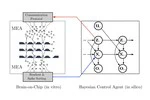
Wouter Kouw develops artificially intelligent systems that learn from interaction with their environment. He focuses on probabilistic machine learning systems where inference and decision-making are implemented as message passing on factor graphs. He derives online system identification algorithms for time-varying dynamical systems and free energy minimizing agents that plan actions to simultaneously learn fast and reach a goal. Much of this work concerns actively pursuing informative data points or trials. Applications include multi-joint dynamical systems, mobile robots, heat transfer processes, traffic management, radar tracking, and neuromorphic computing.
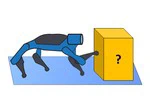
The aim is to bring these agents to legged robot platforms that use contact to resolve perceptual ambiguity and negotiate unknown terrain, with the ultimate goal of automating work that is dangerous or infeasible for humans.
“Intelligence is more than just computation at scale - it’s about making sense of the world under uncertainty.”
- Probabilistic machine learning
- Bayesian system identification
- Active inference agents
- Autonomous robotics
-
PhD in Computer Science, 2018
Delft University of Technology
-
MSc in Neuroscience, 2013
Maastricht University
From models to robots
- Probabilistic models. A probabilistic model expresses beliefs about hidden quantities as probability distributions. Each observation reweights the belief through Bayes' rule, and today's posterior becomes tomorrow's prior.
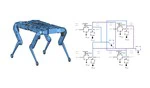
- Message passing on factor graphs. A factor graph splits a large model into small local pieces. Inference becomes local computation: observations and the parameter prior send messages into the graph, messages sweep forward and backward along the edges, and every belief is the product of the messages that meet on its edge. The same messages then flow up to the shared parameters θ, so the model learns while it infers.
- Active inference agents. An agent closes the loop with its world. It infers where it is, imagines the consequences of candidate plans and picks the plan with the lowest expected free energy: a trade-off between risk (missing the goal) and ambiguity (not knowing what is going on). Here it first seeks out an informative landmark before heading to the goal.
- Deployed on robots. The same loop runs onboard a legged robot in a messier world. On slippery ground its uncertainty grows and it slows down, when landmarks come into view it regains confidence, and when a pedestrian crosses its path it yields and replans.
Projects


Publications
Talks
Software

RxInfer is a powerful Julia package for event-driven variational Bayesian inference, and is used for probabilistic machine learning, signal processing, adaptive control and the design of intelligent agents.